TOP
Teachers and Students from Peking University's National Development Research Institute Visit Hanna Motor
— Exploring Practical Collaboration through University-Enterprise Exchange
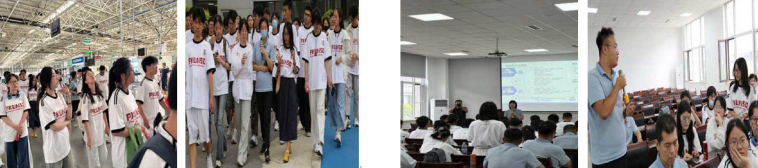
From August 25 to 29, 2025, a delegation of teachers and students from the National School of Development at Peking University (referred to as 'NSD Peking University') carried out an ideological and political practice activity in Jinzhou, Liaoning, with the core theme of 'Experiencing the Red Historical Heritage and Exploring New Chapters of Contemporary Development.' On the afternoon of August 27, the delegation paid a special visit to our company for a study and research tour. This exchange was not only an important part of NSD Peking University's ideological and political practice in Jinzhou but also built a bridge for in-depth dialogue between the university and enterprises, allowing theoretical knowledge and corporate practice to be efficiently integrated and resonate in harmony.

At the start of the event, the seminar commenced in the company's training room. Director Zhang from the Operations Office, along with outstanding key members from production, R&D, and marketing departments, formed a Q&A team. Just after introducing the basic information about the company, the students could barely wait to raise their hands and ask questions, instantly sparking a wave of interaction. "What is the historical development trajectory of Hanner Motors?" "Through which main channels does the company recruit staff and R&D personnel, and what is the scope of recruitment?" "During the process of intelligent transformation, how do you balance the improvement of production efficiency with the need for frontline employees to update their skills?" ... From talent cultivation to business management, from technological application to social responsibility, the students' questions were practical and to the point. Many questions even integrated theoretical models learned in class, demonstrating solid academic competence.
In response to the enthusiastic questions, Director Zhang and key members from each department patiently and thoroughly answered each one. They not only shared specific cases and data but also actively extended the discussion, inviting students to think of solutions in relation to their own majors, turning the seminar from a "one-way Q&A" into a "two-way discussion." Some students, after receiving answers, even followed up with further details. The sounds of discussion and note-taking alternated continuously. The seminar, originally planned for one hour, was extended by 20 minutes due to the lively interaction, yet the students were still eager for more.
After the seminar, the teacher-student delegation went to the production workshop for a visit. The precise operations of the intelligent production line, the visualized quality control processes, and the neat and orderly production environment gave the students a more intuitive understanding of the "refined management" and "technology application in practice" mentioned during the seminar. While observing, they exchanged insights with reference to the seminar content and frequently confirmed details with the workshop staff, deeply integrating theoretical knowledge with real-world scenarios.